Disclaimer: This article is for informational purposes only and does not constitute financial advice. BitPinas has no commercial relationship with any mentioned entity unless otherwise stated.
📬 Get the biggest crypto stories in the Philippines and Southeast Asia every week — subscribe to the BitPinas Newsletter.
This article is part of our Consensus HK 2026 Coverage
In the crypto industry, success is often measured by hype: how loud is your community? How high is your token price?
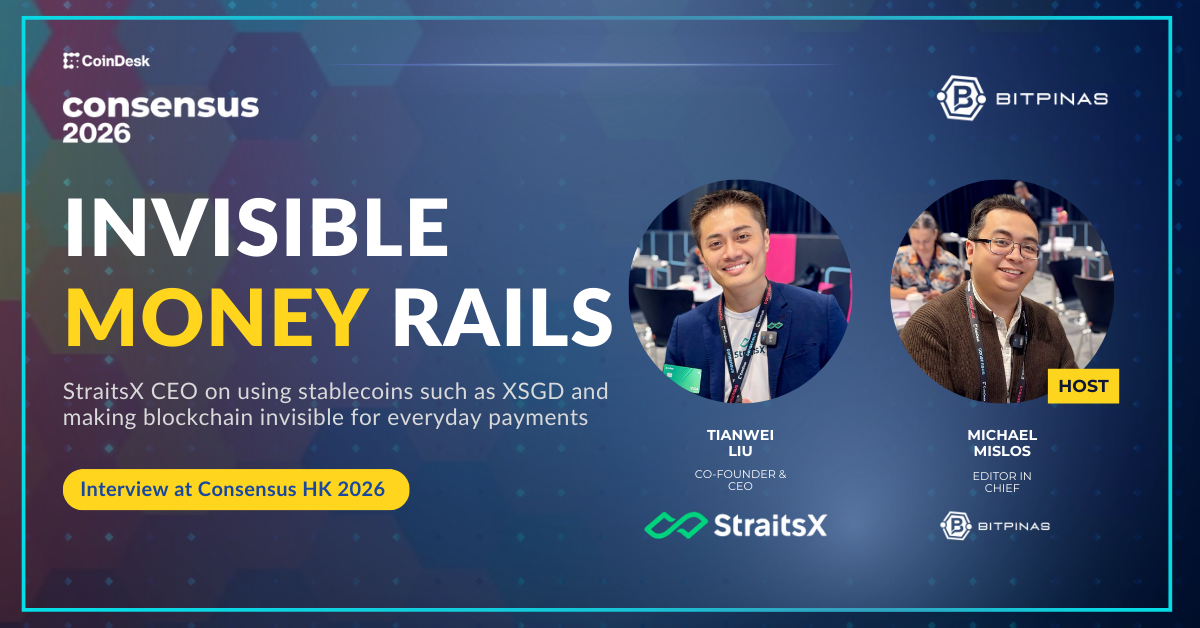
But for Tianwei Liu (LinkedIn, X), the co-founder and CEO of StraitsX, success is when you won’t even know you’re using his product.
“I always say this in interviews: I’m in the payments field for 10 years, and my mom still doesn’t know what I do,” I thought Tianwei was joking in an exclusive interview with BitPinas at Consensus Hong Kong. But it was true.
“To her, she just wants to get her coffee… the technology really scares them.”
This philosophy of hiding the complex “mumbo jumbo” of blockchain behind a seamless user experience has made StraitsX the backbone of digital assets in Southeast Asia. According to a recent PwC report, Singapore dollar-pegged stablecoins now dominate the region, with StraitsX’s XSGD capturing over 70% of the market share.
Now, as a Visa Principal Member and a licensed Major Payment Institution in Singapore, Tianwei is ready to take this “invisible” infrastructure to the rest of Asia, unlocking financial inclusion for millions of underserved Filipinos in the process.
The Strategy: A ‘Stablecoin Sandwich’

The core of StraitsX’s success is what the industry calls the “stablecoin sandwich”: a front-end that looks like a normal e-wallet, a back-end that looks like a normal bank settlement, and a middle layer powered entirely by blockchain speed and efficiency.
A prime example is their partnership with Grab and Alipay+. Travelers to Singapore can pay at hawker centers using their home e-wallets. They scan a QR code, the merchant gets paid in SGD, and the user pays in their local currency.
“This is just an e-wallet Alipay+ payment flow to the merchant… there are no changes in user experience. But behind the scene, every transaction is settled on-chain, real-time with XSGD.”
Tianwei Liu, CEO, StraitsX
Smashing the ‘Financial Inclusion’ Wall
For years, the promise of “financial inclusion” in Southeast Asia has hit a mathematical wall: it is simply too expensive for traditional banks to serve customers with small balances. If a user only has $100 to deposit, the cost of KYC, card issuance, and account maintenance often exceeds the profit.
Tianwei believes stablecoins have finally smashed that wall.
“Now with digitalization and stablecoin, they’ll be happy to serve you even though you only have 10 to 100 dollars.”
Tianwei Liu, CEO, StraitsX

By leveraging blockchain rails to slash the cost of funds from 0.5-0.6% to a fraction of a cent, StraitsX is powering a new wave of “stablecoin neobanks”, which includes platforms like Redotpay, UPay, and Pionex. These platforms can issue Visa cards to people who were previously unbankable. This allows them to hold stablecoins (USDC, USDT, or StraitsX’s XUSD) and spend them instantly at 150 million merchants worldwide.
“That fundamentally changes this whole equation. I’m starting to see what we’ve been promised in fintech for the last 10 years about financial inclusion.”
Tianwei Liu, CEO, StraitsX
Remittance: Beyond the 3-Day Wait
The Philippines is one of the world’s largest remittance markets, yet sending money from financial hubs like Singapore can still take up to three days. This writer shared with Tianwei the frustration of a relative who lost days waiting for funds to clear over weekends or holidays.
The executive said StraitsX is actively working with partners like Coins.ph and PDAX to change this.
“We are really starting to see remittance companies… allowing merchants to send funds directly into Philippine Peso powered by stablecoins.”
Tianwei Liu, CEO, StraitsX
By using XSGD or XUSD as the underlying rail, transfers can settle 24/7/365. While currently in the early stages, daily transactions are already flowing, which proves that the demand for instant, low-cost cross-border settlement is real.
The Future is Wearable
During the interview, Tianwei showed off a glimpse of the future that goes beyond plastic cards: a stablecoin-powered NFC ring.
Now, granted, NFC rings are not new. This writer — who saw one during the previous YGG Web3 Games Summit in Manila, and one worn by a friend — was unconvinced of its usecase. That, until TianWei explained what could possibly be a most important feature for someone who lost lots of wallets when he was younger:
“This is a NFC ring, it doesn’t need to be charged… I can just tap with my knuckles and it will just pay,” he demonstrated.
As digital banks embrace younger, tech-savvy customers, physical wallets are becoming obsolete. Whether it’s tapping a phone via Apple Pay or a smart ring, the form factor is changing, but the rails underneath are increasingly becoming blockchain-based.
For the Philippines, where mobile penetration is high but credit card penetration is low, this leapfrog technology offers a way for millions to access the global digital economy without ever stepping foot in a bank branch.
“The medium is also changing,” Tianwei observed. “I don’t carry a wallet anymore.”
This article is published on BitPinas: The ‘Stablecoin Sandwich’: How StraitsX is Unlocking Financial Inclusion in the Philippines and Beyond
What else is happening in Crypto Philippines and beyond?
