Key Takeaways
- Poland bought 18 tonnes of gold in May 2026, lifting its reserves to 614 tonnes as it chases a 700-tonne goal.
- The WGC found 89% of central bankers expect global official gold holdings to keep climbing into 2027.
- The Czech National Bank has bought gold for 39 straight months, while the Bank of Korea weighs ETF allocations.
Poland and China Lead a Broad Official Buying Wave
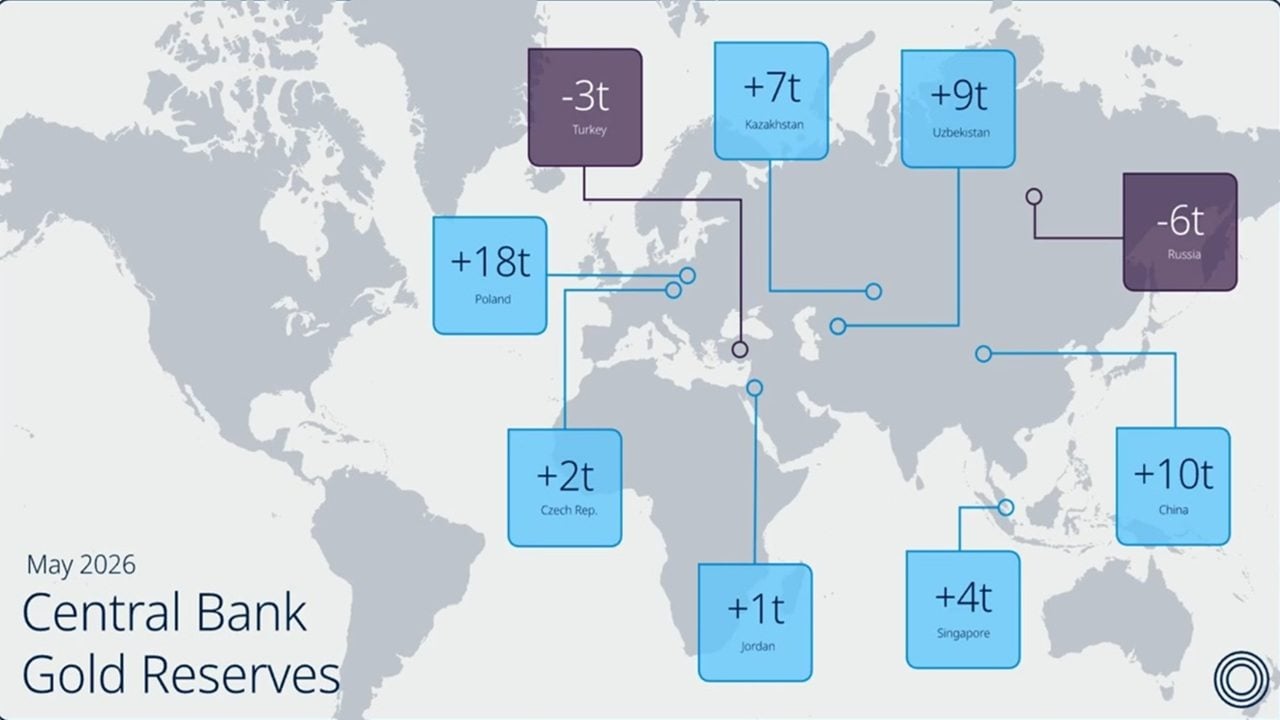
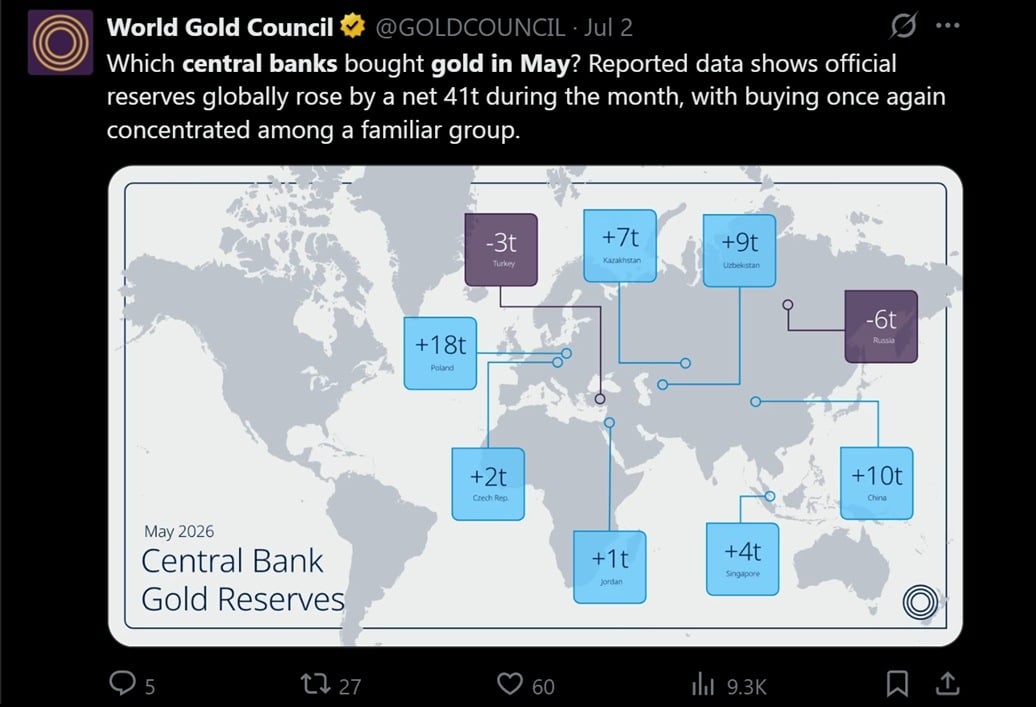
The World Gold Council (WGC), the industry body that tracks official sector bullion flows, detailed the May activity in a research note authored by Marissa Salim, the council’s senior research lead for the Asia-Pacific region. The National Bank of Poland led all buyers with 18 tonnes, followed by the People’s Bank of China with 10 tonnes, Uzbekistan with 9 tonnes, Kazakhstan with 7 tonnes, and the Monetary Authority of Singapore with 4 tonnes.
The council’s 2026 Central Bank Gold Reserves Survey, conducted earlier this year, captured the mood among the world’s reserve managers. The WGC stated:
“89% of central bankers expect global gold reserves to increase in the next 12 months. A record high 45% of central bankers expect their own institution’s gold reserves to increase over the next 12 months.”
Poland has accumulated 64 tonnes in 2026 alone, making it the year’s largest gold buyer as it works toward a publicly stated 700-tonne target. China has added 25 tonnes year-to-date, bringing its official holdings to 2,331 tonnes, or about 9% of its total reserves. Kazakhstan’s stockpile stands at 361 tonnes, roughly 78% of its reserves, while gold makes up 87% of Uzbekistan’s (among the highest allocations in the world).
Not every institution was a buyer as Turkey trimmed 3 tonnes in May and Russia sold 6 tonnes, leaving Moscow with 2,292 tonnes after 34 tonnes of disposals this year. Those sales, however, were dwarfed by demand elsewhere, given the Czech National Bank has now recorded 39 consecutive months of net purchases, one of the longest active streaks among monetary authorities.
A Structural Break From the Last Decade
The current pace represents a departure from historical norms, given that central banks have absorbed an average of 1,000 tonnes annually over the past four years, double the roughly 500 tonnes averaged across the preceding decade, the survey found. The official sector also opened 2026 strongly, with estimated net purchases of 244 tonnes in the first quarter (above both the prior quarter and the five-year quarterly average). Reserve managers cite inflation hedging, sanctions risk, and diversification away from the U.S. dollar as the leading motivations.
The consequences are visible in reserve compositions with gold now accounting for a larger share of global central bank reserves than U.S. Treasuries for the first time since 1996, a shift analysts describe as a turning point in how official institutions store national wealth. Because central banks are among the largest single holders of bullion, their purchases remove supply from the market for years at a time, giving the official sector outsized influence over long-term prices.
Lastly, Goldman Sachs sees 20% upside for gold in 2026, while Devere Group chief executive Nigel Green has argued the metal’s relentless rally has sparked fresh doubts about the Federal Reserve’s next move.
More Buying Incoming?
The Bank of Korea, which holds 104 tonnes, is preparing its first allocations to gold exchange-traded funds (ETFs), a step that would open a new channel for official demand. Chile has added 8 tonnes year-to-date as Latin American interest builds.
Singapore, itself a 4-tonne buyer in May with 197 tonnes in total reserves, plans to launch central bank gold vaulting services in October 2026, positioning the city-state as a custody hub for the very reserves its peers keep accumulating. With 89% of surveyed central bankers expecting global holdings to rise further, the official bid underneath the gold market shows little sign of fading in the second half of the year.
