Algorand (ALGO) has published a detailed post-quantum cryptography roadmap committing the protocol to broad quantum resilience by the end of 2027, covering every layer from user wallets to its core consensus mechanism.
The announcement, made by Bruno Martins, Algorand Foundation technology chief, lands as governments and regulators race to set their own quantum-safe deadlines, and as researchers warn that the cryptographic systems protecting blockchain networks could break as soon as 2030.
ALGO was trading with renewed attention following the announcement, driven in part by a March 2026 Google research paper that assessed Algorand as likely the most quantum-ready blockchain among major Layer-1 networks.
The central question the roadmap forces is this: can Algorand complete a full-stack cryptographic overhaul across consensus, accounts, and tooling, without fracturing its existing developer ecosystem – before a capable quantum computer arrives?
DISCOVER: The Next 1000x Crypto Gem Before It Lists on Binance
Why Quantum Computing Is a Real Threat to Blockchain Security
Today’s blockchains rely on elliptic-curve cryptography, a mathematical system where the security comes from how hard it is for a classical computer to reverse-engineer a private key from a public one.
Quantum computers threaten to collapse that assumption entirely. A sufficiently powerful quantum machine could derive private keys from public addresses, meaning any exposed public key becomes a liability rather than a safe identifier.
Google researchers said in their March 2026 paper that quantum computers may require fewer resources than previously estimated to crack the cryptography protecting blockchain networks.
Most quantum security takes are either alarmist or dismissive, and neither one is useful if you're actually responsible for a live network.
Here's what we're doing instead
— Bruno (@bmartins_) June 18, 2026
California Institute of Technology researchers have separately theorized that a functional quantum computer capable of this could be deployed before 2030. A Glassnode report noted that nearly 10% of Bitcoin’s supply sits in addresses whose public keys are already exposed on-chain, structurally vulnerable the moment that threshold is crossed.
Post-quantum cryptography (PQC) replaces elliptic-curve methods with mathematical problems that remain hard even for quantum machines, lattice-based schemes being the leading candidate. Falcon, a lattice-based digital signature scheme selected by the US National Institute of Standards and Technology (NIST) for standardization, is Algorand’s chosen instrument for this transition.
DISCOVER: Best Meme Coin ICOs to Invest in 2026
Algorand’s Roadmap: What Changes and When
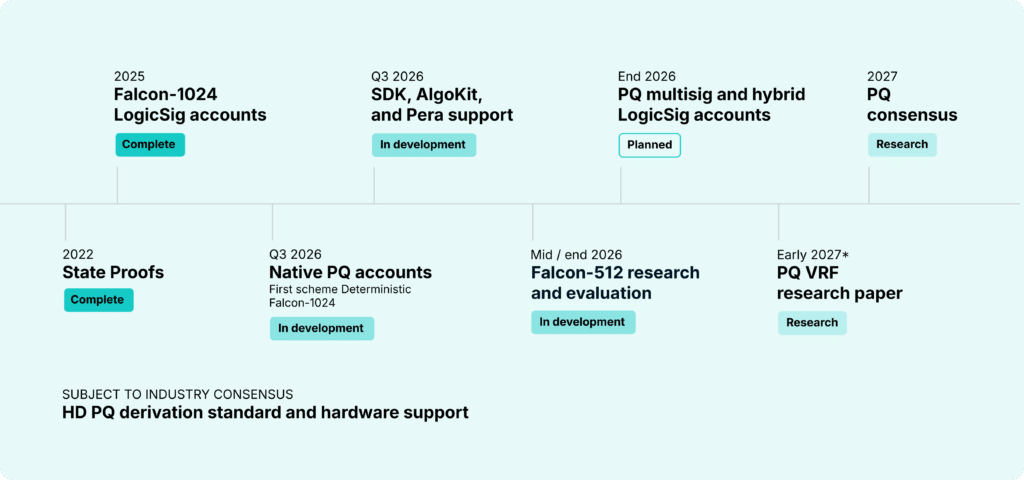
Algorand is not starting from zero. Falcon-signed State Proofs, which protect the historical integrity of the chain across cross-chain interoperability, have been live on mainnet since August 2022.
By early 2026, over 140,000 quantum-resistant transactions had already been recorded on Algorand’s mainnet, with the first fully Falcon-signed transaction completing on November 3, 2025. The remaining vulnerability sits in the consensus layer, which still uses classical Ed25519 signatures for validator selection and block proposals.
The roadmap runs in three defined phases. In Q3 2026, native post-quantum accounts based on Falcon-1024, the higher-security parameter variant of the Falcon scheme will be introduced at the protocol level, alongside SDK and Pera wallet updates so developers and users can create PQ accounts immediately.

Q4 2026 adds post-quantum multi-signature support for institutional wallets and treasuries; the Algorand Foundation will begin migrating its own treasury to PQ accounts during this phase, and stakers will be able to stake directly from PQ-secured accounts.
The 2027 phase is the most technically complex. It targets a post-quantum Verifiable Random Function (VRF), the mechanism that drives Algorand’s validator selection process, to replace the current elliptic-curve-based version. It also introduces hybrid accounts that combine classical and Falcon signatures, allowing institutions and protocols to maintain dual-stack operation during the transition rather than forcing an abrupt cutover.
The roadmap reflects similar architectural thinking to Cardano’s approach to phased protocol-level upgrades, where backward compatibility is preserved across hard milestones.
EXCLUSIVE: Earn $10 USDC Via Binance Sign-Up
EXPLORE: Best Crypto Presales With Asymmetric Upside in the Current Market
The post Algorand Will Unveil Full Quantum Resistance Plan By End of Year appeared first on 99Bitcoins.
