
Key Takeaways
- Capriole Investments warns every inflation spike to current levels has triggered a 30% average market drop historically.
- The 2000 crash (-47%) and 2008 crash (-55%) represent the worst-case range in Capriole’s historical dataset.
- U.S. CPI hit 3.8% recently, its highest since May 2023, sustaining pressure on the Fed and risk assets.
Historical Data Paints a Bleak Picture
Capriole Investments highlighted a pattern that has held across decades of market data, i.e., when inflation crosses as high as it has today, the broad market has declined by an average of 30% over the following one to 24 months.
Two of the most severe crashes on record occurred within this exact inflation regime, namely the dot-com collapse that erased 47% of market value between 2000 and 2002, and the 2008 financial crisis that took markets down by 55%.
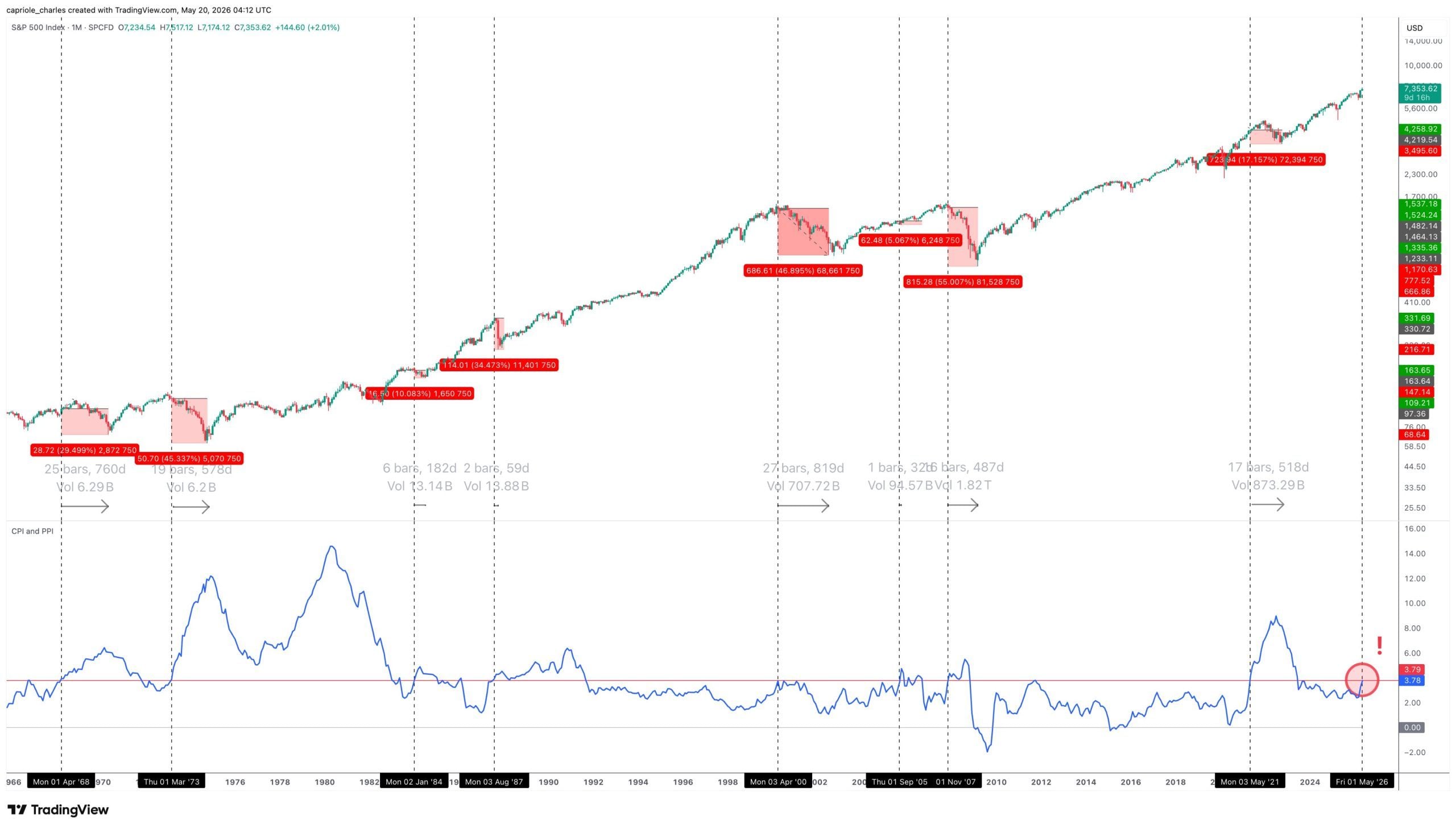
The U.S. Consumer Price Index (CPI) rose 0.6% on a seasonally adjusted basis in April 2026, pushing the annual inflation rate to 3.8%, its highest reading since May 2023. Producer price inflation has also run hot, adding to the Federal Reserve’s difficulty in signaling rate cuts.
With the 30-year Treasury yield having briefly touched 5.19% yesterday and equity markets sitting near all-time highs, Capriole’s argument is essentially that the market is mispricing risk.
Bitcoin Faces Macro Spillover Risk if Stocks Crack
For bitcoin and the broader crypto market, the implications are direct. Bitcoin has spent significant portions of 2026 under pressure, falling below $80,000 multiple times amid inflation concerns and spot ETF outflows, and touching a cycle low near $60,000 in February.
Capriole’s analysis does not target a specific crypto price level but instead focuses on the macro environment that surrounds it. However, if traditional markets experience the kind of average drawdown the historical data implies, risk assets, including bitcoin and altcoins would be unlikely to escape the fallout.
The caveat in Capriole’s framework is the width of the outcome distribution because while the 30% average captures the central tendency, the actual range is wide. On the rare occasions when inflation has been sustained above these levels rather than reverting quickly, markets have gone on to experience the most severe crashes in the dataset.
The critical variable is not whether a crash occurs in this environment but how long inflation persists, and whether the Fed moves to cut rates before growth cracks visibly.
This macro backdrop sits alongside a more optimistic read from some crypto-specific analysts. K33 Research, which Bitcoin.com News reported on recently, has argued that bitcoin’s February low near $60,000 may already represent the bear market’s maximum drawdown, with slow consolidation between $60,000 and $75,000 the more likely near-term path.
