
Key Takeaways:
- Cryptoquant data shows bitcoin’s April 2026 rally from $66K to $79K was driven entirely by perpetual futures demand, with zero spot support.
- Bitcoin’s Cryptoquant Bull Score dropped from 50 to 40 by month’s end, signaling deteriorating onchain fundamentals after the speculative run.
- Cryptoquant researchers warn that the current demand pattern mirrors 2022’s bear market onset, putting $79K resistance at risk of further rejection.
Bitcoin Futures Traders Pushed BTC to $79K While Spot Demand Stayed Negative, Data Shows
According to Cryptoquant‘s latest report, bitcoin‘s apparent demand metric, which tracks the 30-day change in estimated onchain spot buying activity, stayed negative for the full duration of April’s price run. Perpetual futures demand expanded during the same window as speculative traders pushed prices higher through leverage rather than direct coin accumulation.
Cryptoquant researchers describe the gap between rising futures activity and contracting spot demand as one of the clearest onchain signals that price gains are speculative in nature. When spot demand falls while price climbs, the market’s marginal buyer is positioned in derivatives, not in actual bitcoin.
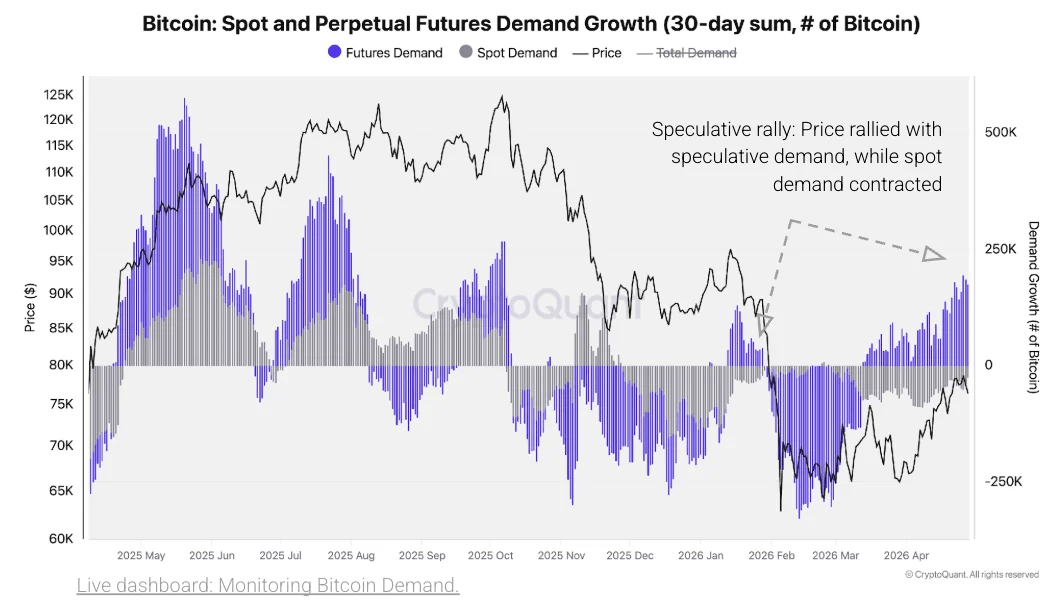
The analyst’s phased breakdown of demand data makes the dynamic hard to dispute. Each phase of April’s rally showed higher perpetual futures demand alongside negative spot apparent demand. This was not a case of spot buyers lagging behind and catching up. Spot demand actively contracted as futures activity climbed.
Cryptoquant market strategists note that rallies with this structure tend to be self-limiting. Without fresh spot demand to absorb elevated prices, the unwind of futures positioning becomes the primary driver of the next decline.
The historical parallel Cryptoquant researchers draw is direct and worth taking seriously. The same demand signature appeared at the onset of the 2022 bear market, when perpetual futures demand expanded in isolation while spot apparent demand stayed in contraction. That setup preceded a multi-month price decline. Cryptoquant applies onchain demand decomposition consistently across cycles and identifies this pattern as a reliable early indicator of price fragility.
Bitcoin has already begun pulling back from the April peak. Price slipped from $79,000 to $75,000 following the rally’s high, a move consistent with how futures-led rallies historically resolve once speculative positioning begins to unwind. As of Saturday, May 2, BTC is exchanging hands just above $78,000 after trying again to reach the $80,000 mark.
Cryptoquant’s Bull Score Index declined from 50 to 40 in April, crossing back below the neutral threshold and returning to bearish territory. The index briefly reached 50, neutral ground, in mid-April before sliding to 40 by month’s end despite the 20% price gain during that stretch. Cryptoquant describes a score of 40 as conditions “getting bearish,” placing the market in a range historically associated with continued price weakness.
The Bull Score is a composite index Cryptoquant builds from multiple onchain and market indicators, scaled from 0 to 100. Scores above 50 reflect bullish conditions. Scores below 50 reflect bearish conditions. The market action also coincides with the U.S.-Iran conflict and geopolitical rumblings. Yesterday, Trump said the conflict was over, which gave bitcoin another boost alongside equities.
Cryptoquant analysts conclude that without a reversal in apparent demand from negative to positive territory, any push back toward the $79,000 local peak will lack the on-chain support needed to produce a sustained breakout.
The data does not guarantee a repeat of 2022’s prolonged downturn, but Cryptoquant makes clear the current demand structure matches the historical profile of price fragility, not accumulation.
