
Hormuz Crisis Deepens: Iran Rejects Peace Plan, Crude Oil Climbs
Tehran’s foreign minister, Abbas Araghchi, dismissed the plan as “one-sided” and “maximalist,” calling U.S. claims of productive negotiations “fake news.” Iranian state media rejected the proposal outright, with officials saying Iran would “end the war when it decides to.”
The Trump administration transmitted the 15-point framework to Tehran via Pakistani intermediaries on or around March 24. The plan included a 30-day ceasefire, sanctions relief, civilian nuclear cooperation, curbs on Iran’s ballistic missile program, enhanced IAEA monitoring, and guaranteed shipping access through the Strait of Hormuz.
Iran countered with five demands: a complete halt to U.S. and Israeli strikes, verified mechanisms against resumed hostilities, war reparations, Iranian sovereignty over the Strait of Hormuz, and a full end to sanctions.
Brent crude had fallen roughly 11% from a $112 peak earlier in the week as markets responded to the proposal’s emergence and a temporary U.S. pause in strikes. The rejection reversed those gains. By early afternoon Eastern time on Friday, Brent was trading near $104–$106 after touching above $108, while West Texas Intermediate (WTI) approached $95. Heating oil climbed more than 6% intraday.
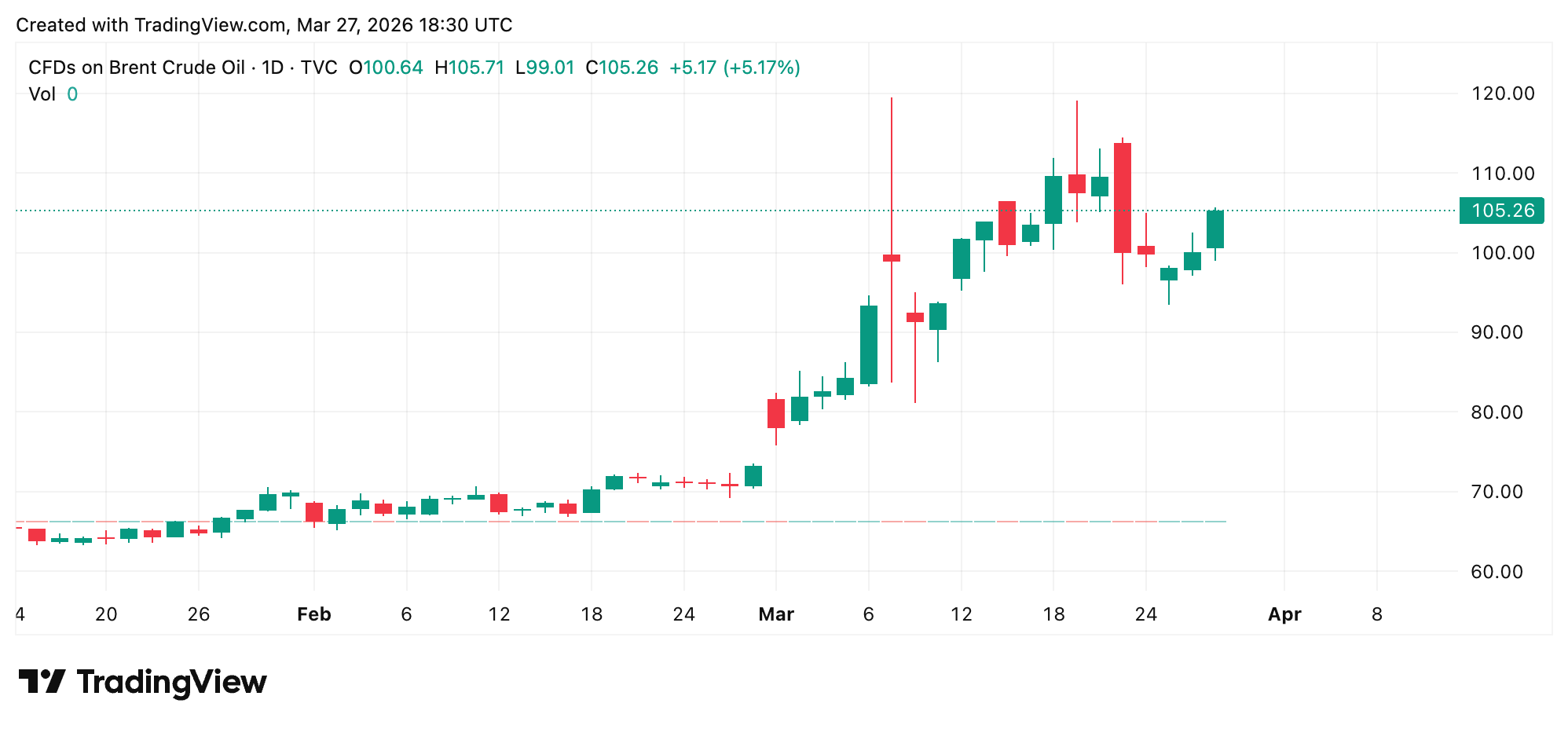
The Strait of Hormuz, through which roughly 20% of global seaborne oil and LNG passes, has been effectively closed to normal traffic since March 2, when IRGC forces began threatening vessels transiting the waterway. Shipping volume has dropped more than 95% from normal levels.
Qatar‘s LNG exports are running roughly 17% below capacity. Kuwait has declared force majeure. Analysts estimate the disruption is removing 13 to 14 million barrels per day from global supply in a prolonged scenario.
The conflict began in late February 2026 with U.S. and Israeli strikes on Iranian targets, including energy infrastructure. Brent crude was trading near $60–$70 per barrel before the war. Prices reached $120 during the sharpest phase of the crisis.
Equity markets in the U.S. bore the pressure on Friday afternoon. By 2 p.m. Eastern time, the Dow Jones Industrial Average fell 603.26 points to 45,356.85. The S&P 500 dropped 86.18 points to 6,390.98. The Nasdaq Composite lost 404.39 points, hitting 21,003.69, and the NYSE Composite declined 132.38 points to 21,711.59.
Energy stocks have outpaced the broader market since the conflict began. Exxon-Mobil and Chevron are up roughly 35% since late February, though analysts say both still lag Brent’s total price gain. Further upside is possible if prices remain elevated.
Central banks in Europe, Asia, and the Americas are contending with rising energy-driven inflation. The shock draws comparisons to 1970s-era oil crises in scale, with analysts flagging downstream effects on medicine, semiconductor, and consumer goods supply chains.
Trump: Talks Are Ongoing Despite ‘Fake News Media’ Reports
President Trump threatened to escalate strikes against Iranian energy sites if ceasefire talks collapse, while extending some deadlines tied to Hormuz-related actions.
“As per Iranian Government request, please let this statement serve to represent that I am pausing the period of Energy Plant destruction by 10 Days to Monday, April 6, 2026, at 8 P.M., Eastern Time,” Trump wrote on Truth Social. “Talks are ongoing and, despite erroneous statements to the contrary by the Fake News Media, and others, they are going very well. Thank you for your attention to this matter,” he added.
Alternative pipeline routes through Saudi Arabia, the UAE, and Iraq can partially offset Hormuz disruption, but analysts say full replacement of seaborne volumes is not possible in the near term.
Markets remain sensitive to any escalation or diplomatic shift. With Iran holding its position and Washington issuing threats, prices above $100 per barrel may persist through the medium term. Today, Trump noted that he had plans to make a “big speech” on economics in Miami and further added:
“Our Military Operation in Iran is going GREAT!”
FAQ 🧭
- What did Iran reject? Iran reportedly dismissed a U.S.-brokered 15-point ceasefire proposal that included sanctions relief, missile program restrictions, and Strait of Hormuz shipping guarantees.
- Why did oil prices rise after the rejection? Markets had priced in ceasefire optimism earlier in the week; Iran’s refusal renewed fears of a prolonged Hormuz closure, cutting off roughly 20% of global seaborne oil and LNG supply.
- How are U.S. stock markets reacting? The Dow, S&P 500, Nasdaq, and NYSE Composite all fell sharply on March 27 as investors moved away from risk assets following the diplomatic breakdown.
- What happens next in the Iran-U.S. conflict? President Trump has threatened to escalate strikes on Iranian energy infrastructure if talks fail, while Iran insists it will determine the conflict’s end on its own terms.
